

Italy is not a cheap country any more — anyone who has paid €5 for a bottle of water outside the Colosseum knows that. But a self-catering holiday changes the maths completely. When you control the kitchen, the laundry and the bedtime routine, a fortnight in Tuscany or Puglia can land closer to a package week in Spain than you'd expect. Here are ten tactics UK families actually use, tested on school-holiday budgets and toddler patience levels.
First, a quick reality check on the numbers
Before the tips, it helps to see roughly where the money goes. Below are the live and estimated figures we're working with at the time of writing — everything else in this article is built around trimming these four lines.
| What you're booking | Typical cost | Notes |
|---|---|---|
| Budget flight from London to Rome | from £41 | One way, hand luggage only, off-peak dates |
| Budget flight from Manchester to Pisa | from £61 | Handy for Tuscany, Lucca and the Ligurian coast |
| Self-catering apartment in Tuscany | estimated £450–£700 (estimate – not verified against live prices) | Per week, family of four, rural or small-town location |
| Self-catering villa near Rome | from £735.65 | Per week, sleeps a family with room for grandparents |
Two adults and two children flying from London to Rome and back, on the lowest fares above, is roughly £164 in flights before bags. Add the villa and you're at around £900 for the two biggest lines on the budget. Everything from here is about stopping the other £900 quietly appearing.
1. Book the flights before you book anything else

Flight prices to Italy move far more than accommodation prices do. Ryanair, easyJet, Jet2 and Wizz all fly the main routes, and the same seat can double between a Tuesday in May and a Saturday in August. Use a comparison site to find the cheap day, then build the holiday around it rather than deciding on dates first and paying whatever the airline asks.
Two habits that save real money: fly out on a Tuesday or Wednesday where school terms allow, and check the second airport. Bologna, Ancona, Perugia and Genoa often undercut Pisa and Rome by £40 a head, and the extra hour in the car is usually cheaper than the fare difference.
A word on the small print — budget airlines are strict on cabin bag dimensions, and gate fees for an oversized bag can wipe out everything you saved. Measure at home with the actual bag packed, not empty.
If the flight goes wrong
**#ad** — This article contains affiliate links. If you book through them we may earn a commission at no extra cost to you.

Delays and cancellations on European routes carry statutory compensation rights, and airlines rarely volunteer them. If your flight to or from Italy is delayed more than three hours or cancelled at short notice, it's worth running the claim through a specialist rather than letting it lapse — <a href="https://www.dpbolvw.net/click-101872474-17238636-1778627423000?utm_source=familymilesguide&utm_medium=article&utm_campaign=money-saving-tips-family-self-catering-italy&utm_content=money-saving-tips-family-self-catering-italy" rel="nofollow sponsored" target="_blank">check your flight compensation eligibility with AirAdvisor</a>. A family of four on a delayed flight can be owed several hundred pounds, which is a meaningful chunk of a self-catering week.
2. Choose the apartment by its kitchen, not its photos
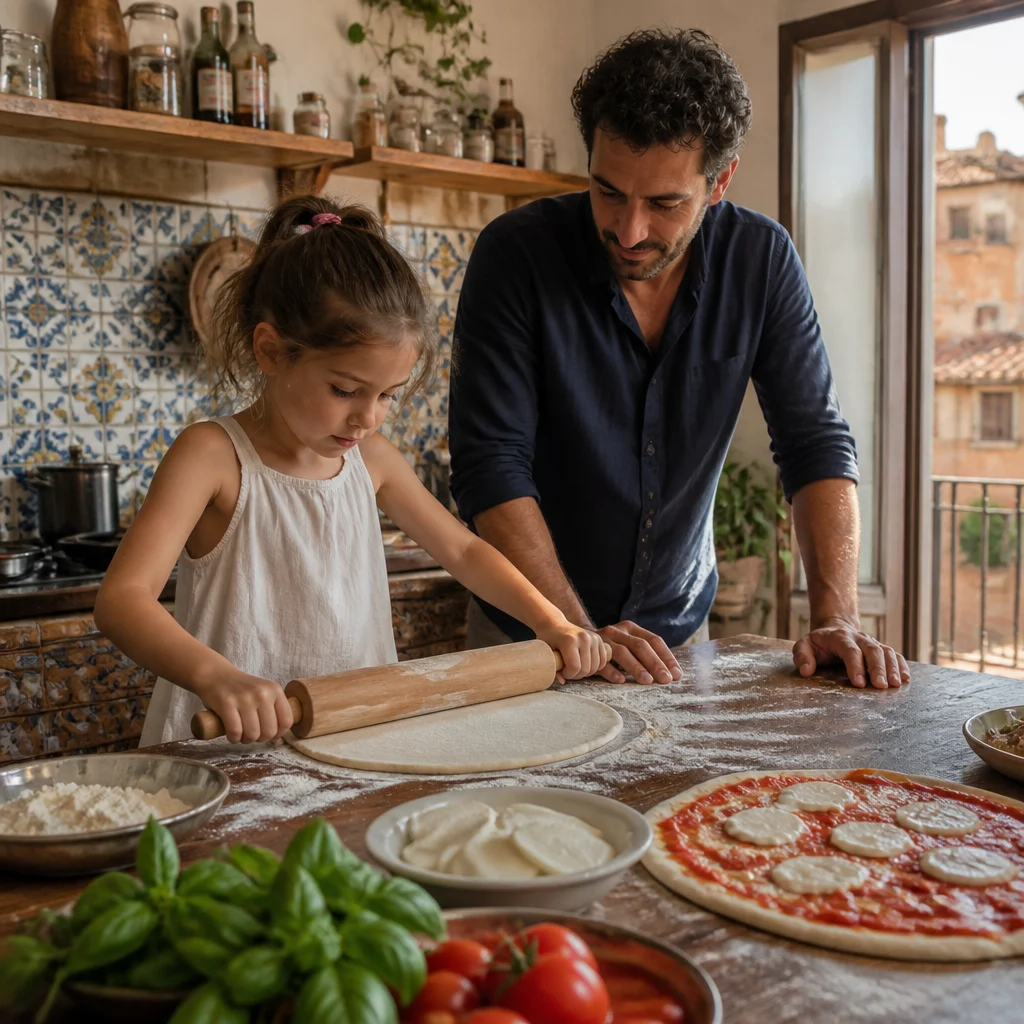
The single biggest saving in self-catering is not the nightly rate — it's the meals you don't buy. That only works if the kitchen is genuinely usable. Filter listings for a proper oven, a hob with four rings, a fridge with a freezer compartment, and ideally a washing machine. A "kitchenette" with two induction rings and a microwave will have you eating out by day three.
Look at the listing photos properly. Is there a table big enough for four to eat at? Is there a dishwasher, or are you scrubbing pans for an hour every night of your holiday? Ask the host directly about aircon, because inland Italy in July and August is brutal and a bedroom without it means nobody sleeps.
Location is the other half of the equation. A villa five minutes from a town with a supermarket, a bakery and a pizzeria will cost you less overall than a cheaper one twenty minutes up a gravel track, where every forgotten pint of milk becomes a 40-minute round trip in the heat.
Rural Tuscan apartments sit at estimated £450–£700 (estimate – not verified against live prices) per week for a family of four, while a self-catering villa near Rome currently comes in from £735.65 — a useful benchmark when you're weighing up whether a place is fairly priced. You can compare family self-catering apartments and villas across Italy on Booking.com to see how the two regions stack up on your dates.
3. Shop where Italians shop

Supermarket choice matters more in Italy than at home. Esselunga, Coop, Conad and Carrefour are the mainstream chains; Lidl, Eurospin and MD are the discounters. A week's groceries for four at Eurospin can run 30–40% below the same basket at a tourist-facing minimarket in a hilltop town.
Three things worth knowing:
- Weigh and label your own fruit and veg. Most Italian supermarkets have scales in the produce aisle with numbered buttons. Turning up at the till with an unlabelled bag of nectarines is the classic British error and holds up the queue.

- Bring a €1 or €2 coin for the trolley, and reusable bags — carriers are charged for and are notoriously flimsy.

- Buy the house-brand pasta, tinned tomatoes and olive oil. Italian supermarket own-label is generally excellent and a fraction of the price of anything branded for export.
Grocery delivery does exist — Esselunga and Carrefour both run online orders in larger cities, and Amazon.it delivers pantry items — but rural addresses and short-stay holiday lets often fall outside the delivery zones. Check before you rely on it, and have a supermarket plan B.
4. Do one market shop, properly
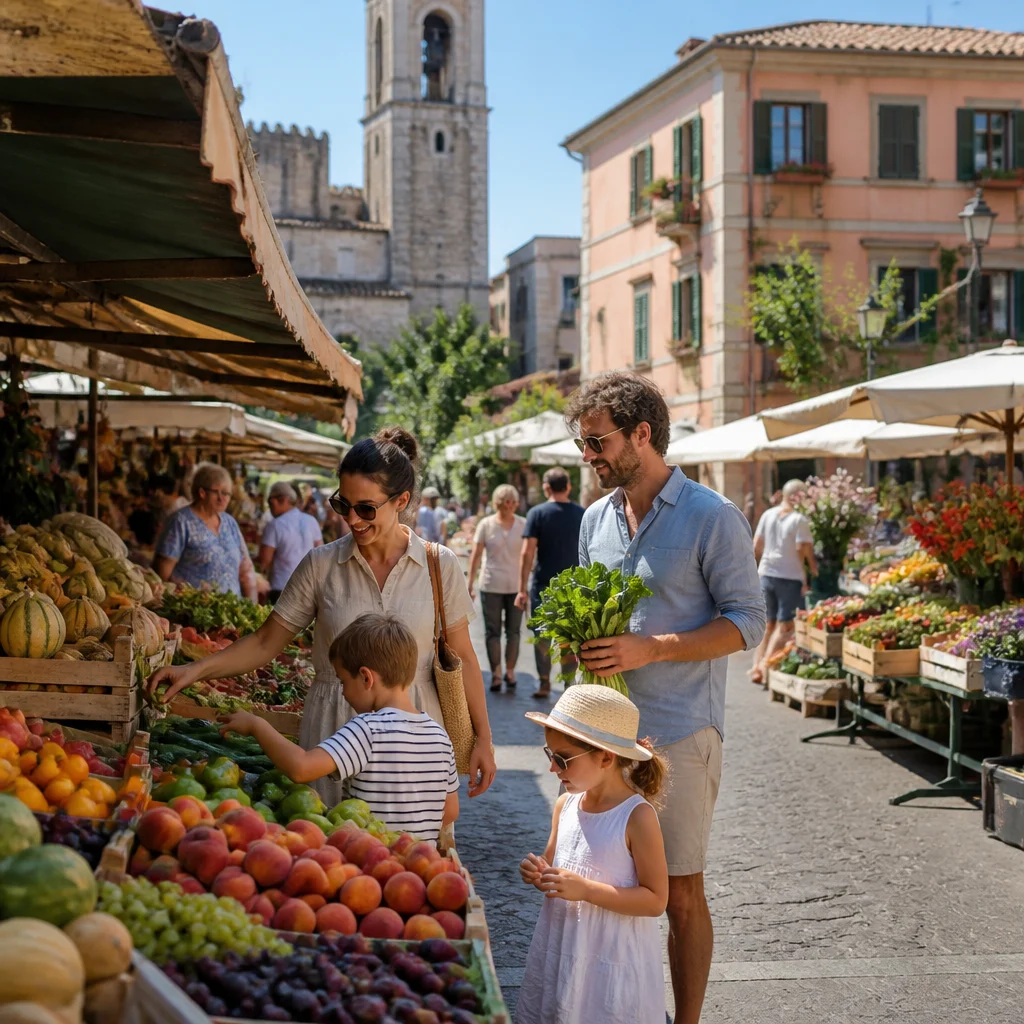
Every Italian town has a weekly market, usually on the same morning it has had for four hundred years. Prices for fruit, vegetables, cheese and cured meat are typically better than the supermarket, and the quality is a different category altogether.
Our own conversion moment came at the Wednesday market in a small Umbrian town, standing in front of a trestle table of peaches so ripe the whole stall smelled like jam. A wasp was doing lazy circuits over the crate. The stallholder shoved a bag into my eight-year-old's hands, said something fast and cheerful I didn't catch, and charged us €2.40 for what turned out to be a kilo and a half. We ate them for breakfast for three days, sticky-handed on the terrace, and the kids still bring it up.
Go early — by 12.30 the good stuff is packed away. Take small notes; nobody wants to break a €50 for a bag of courgettes.
5. Front-load the picnic, not the restaurant

Lunch is where family budgets in Italy quietly haemorrhage. A sit-down lunch for four in a tourist centre, with drinks and a cover charge, lands at €60–€90 without much effort. A picnic of focaccia, prosciutto, tomatoes, peaches and a bottle of water from the supermarket costs a fraction of that and takes ten minutes to assemble.
Reverse the usual rhythm: picnic at lunchtime, and if you're eating out, do it in the evening at a local trattoria away from the main square. Order the menu del giorno if there is one. Split adult portions between children — most kitchens are entirely relaxed about it, and a plate of pasta al pomodoro off the menu is usually €6–€8 anyway.
Also: acqua del rubinetto is tap water, it's safe across almost all of Italy, and public drinking fountains (nasoni in Rome) are free and cold. Refillable bottles will save a family upwards of €10 a day in August.
6. Let the free attractions do the heavy lifting
Italy's best days out for children often cost nothing. Beaches with public sections (spiaggia libera) sit right alongside the paid loungers. Churches, piazzas, fountains and most historic town centres are free to wander. State museums run free admission on the first Sunday of the month, and under-18s from any country get free entry to state-run museums and archaeological sites — including the Colosseum, the Uffizi and Pompeii, though you still pay a small booking fee per ticket.
That last point is worth repeating because it changes trip planning: a family of four visiting the Uffizi is often paying two adult tickets, not four. City passes like the Roma Pass or Firenze Card can still make sense for adults doing three or more paid sites in a short window, but do the arithmetic on your actual itinerary before buying — with free child entry, the break-even point moves.
7. Think hard about the hire car
A car is close to essential for a rural agriturismo and close to useless in Rome, Florence or Venice. Italian city centres are ringed by ZTL zones — limited traffic areas monitored by camera — and the fines arrive by post months later, often with an admin fee from the hire company on top.
If your base is a city or a well-connected coastal town, skip the car and use trains. Regional services are cheap, children under four travel free and under-12s get substantial discounts. For longer hops and ferry legs — Naples to the islands, or crossings to Sicily and Sardinia — it's worth comparing train, bus and ferry routes on 12Go before defaulting to a car.
If you do hire, book in advance, decline the airport's excess insurance and buy standalone car hire excess cover from a UK provider instead — it's typically a quarter of the price. Check whether your accommodation has free parking, because paid parking in Italian towns adds up fast.
Mistakes we've made so you don't have to
  - Booking a place with "sea view" three hairpin kilometres above the sea. The view was lovely. The daily descent with beach kit and two tired children was not, and we ended up driving and paying for parking every single day.

  - Assuming the supermarket would be open on Sunday afternoon. In smaller towns, many close from around 1pm Saturday until Monday morning. Shop Friday.

  - Ignoring the tourist tax. Most Italian towns charge €1–€5 per adult per night, payable in cash on arrival, and it isn't included in your booking total. Budget roughly €40–£50 for a week and don't be caught out.

  - Booking a beach club for the week on day one. We used it twice. The free stretch of sand fifty metres along was perfectly good.
8. Pack the things that stop you buying them there
Self-catering rewards a slightly ruthless packing list. The following items routinely cost £30–£50 to replace at destination prices, and weigh almost nothing:
- Suncream — genuinely expensive in Italian pharmacies and seaside shops

- Calpol or equivalent, plus plasters and antihistamines

- Two or three plug adaptors, not one

- A collapsible cool bag for beach and market days

- Refillable water bottles for everyone

- Beach toys from a UK pound shop rather than the €8 buckets at the resort kiosk

- Tea bags, if you're the kind of family who will otherwise pay €4 for a box of four
Leave space for the return leg: olive oil, pasta and vacuum-packed pecorino are the best souvenirs Italy sells, and they're all cheaper there.
9. Travel in the shoulder, if you possibly can
Late May, early June and September are the sweet spot for Italy: the sea is warm, the crowds are thinner and accommodation drops noticeably against the August peak. Families tied to school holidays have less room to manoeuvre, but even within August, the last week is usually softer than Ferragosto (15 August), when Italy itself goes on holiday and prices in coastal resorts peak.
If you're travelling with pre-school children, use the freedom while you have it. The difference between a July and a June week on the same property can easily be £200.
10. Stay longer in fewer places
The most common budget mistake we see is trying to fit Rome, Florence, Venice and the Amalfi Coast into ten days. Every move costs you a transfer, a check-in fee, a cleaning charge and usually a restaurant meal because the new kitchen is empty.
One base for a week, with two or three day trips out, is cheaper and far calmer with children. Weekly rates are also better than nightly ones — many hosts discount by 10–20% for a seven-night stay, and it's often worth checking weekly versus nightly rates on the same property before you commit.
Putting it together
A family of four flying from Manchester to Pisa on fares from £61, staying a week in a Tuscan apartment at estimated £450–£700 (estimate – not verified against live prices), self-catering four nights out of seven and using free child museum entry, lands somewhere near the cost of a mid-range package week — with a garden, a washing machine and no queue for the buffet. The savings aren't in one dramatic decision. They're in twenty small ones, most of which you make before you leave the house.
Frequently asked questions
Is self-catering actually cheaper than a package holiday in Italy?
For families of four or more, usually yes — mainly because you're not paying restaurant prices for three meals a day and you're not paying per-person supplements for children. For couples or families of three staying under five nights, the gap narrows considerably and a half-board deal can win.
How much should I budget for food per week?
A family of four self-catering most meals, with two or three evenings out, typically spends around €150–€250 per week on groceries plus €120–€200 on eating out, depending on region. Southern Italy and inland areas are cheaper than Liguria, Lake Garda and the Amalfi Coast.
Do children pay to enter museums in Italy?
Under-18s of any nationality get free entry to Italian state museums and archaeological sites, including the Colosseum, the Uffizi and Pompeii. You may still pay a small mandatory booking or reservation fee per ticket. Privately run attractions set their own rules, so check individually.
Do I need a hire car for a self-catering holiday in Italy?
Only if you're staying rurally. For city or well-connected coastal bases, trains and buses are cheap and avoid the risk of ZTL fines in historic centres. Check whether your accommodation includes parking before deciding.
What is the tourist tax and do families have to pay it?
Most Italian municipalities charge a per-person, per-night tax of roughly €1–€5, usually payable in cash on arrival and not included in your booking total. Children under a certain age — often 10 or 12, but it varies by town — are typically exempt. Ask your host in advance.
When is the cheapest time to visit Italy with children?
Late May to mid-June and the whole of September offer the best balance of warm weather and lower prices. Avoid the week around Ferragosto (15 August), when domestic demand pushes coastal prices to their annual peak.
Sources / Prices checked
  - Flight fares (London–Rome from £41; Manchester–Pisa from £61) taken from live fare feed, one-way, lowest available fare, hand luggage only.

  - Self-catering villa near Rome from £735.65 — live accommodation feed, per week, family occupancy.

  - Self-catering apartment in Tuscany estimated £450–£700 — estimate, not verified against live prices.

  - Food, tourist tax and museum admission figures are indicative ranges based on published municipal tariffs and Italian Ministry of Culture admission policy, not live feed data.

  - Prices checked: June 2025. Fares and nightly rates change constantly — always confirm on the booking page before you commit.


Disclosure: this article contains affiliate links marked #ad. If you book through them, Family Miles Guide may earn a commission at no additional cost to you. This does not affect which services we recommend.


